
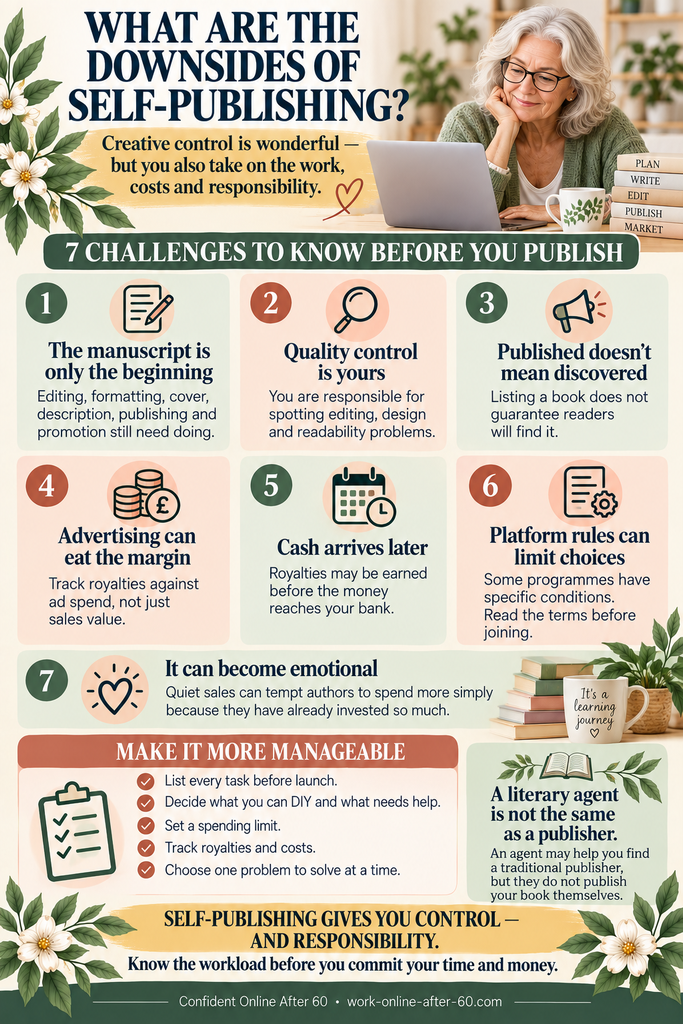
The main downsides of self-publishing are the workload, uncertain sales, upfront costs, responsibility for quality and the need to find readers. You gain control over your book, but you also take on jobs that a publishing team might otherwise share.
During my three years with Amazon KDP, the pressure to keep funding advertising and the wait for royalty payments were especially frustrating. Understanding those pressures before you publish can help you make a calmer decision about your time and money.
1. The manuscript is only one part of the job
A finished manuscript still needs editing, formatting, a cover, a description and a publication plan. After launch, there is promotion, administration and possibly updating the book. Doing every task yourself can stretch a project far beyond the writing stage.
A practical response: List the tasks before setting a launch date. Decide what you can do well, what you can learn and what might need paid help. Keep the first project manageable rather than trying to publish several formats simultaneously.
2. Creative control brings quality-control responsibility
You choose the content and presentation, which is a real benefit. You also have to notice when the cover gives the wrong impression, the interior is difficult to read or the manuscript needs another edit. Familiarity with your own writing can make errors harder to spot.
A practical response: Separate drafting from proofreading. Ask an appropriate reader for specific feedback and check a proof in the format people will use. A cover that looks clear on a large screen should also be recognisable as a small image.

3. Being listed does not mean being discovered
Publishing makes a book available. It does not guarantee that the right people will notice it or understand why they would enjoy it. Amazon’s merchandising guidance discusses descriptions, author profiles and promotion alongside the book itself.
A practical response: Describe one intended reader and their reason for choosing the book. For fiction, that could be a particular reading experience; for nonfiction, a question the book helps answer. Use that understanding to improve the description and choose relevant places to share it.
4. Advertising can consume the margin
In my experience, maintaining enough sales felt tied to regular ad spending. Other authors may build readership differently. The problem to watch is paying more to acquire a sale than that sale contributes to your business.
A practical response: Set a test budget and record royalties alongside spend. If an ad dashboard shows retail sales value, do not mistake that value for the royalty you receive. Future sales of other books may matter, but they should be measured rather than assumed.

5. Cash arrives later than the sale
Royalty reporting and bank payments happen on different schedules. That can be awkward when current costs depend on money you have earned but have not received. Our guide to whether you can make money self-publishing explains KDP’s payment timing and a simple profit calculation.
A practical response: Keep a calendar of expected receipts and bills. Decide in advance how much you can spend without relying on the next royalty payment.
6. Platform rules can limit your choices
Different distribution arrangements come with different conditions. For example, enrolling a Kindle eBook in the optional KDP Select programme involves a 90-day digital exclusivity commitment. This is not a blanket rule for every KDP book. Read Amazon’s KDP Select requirements before enrolling or distributing that eBook elsewhere.
A practical response: Keep a record of the programmes you join and their renewal dates. Read the terms for the specific format and arrangement rather than relying on advice about another author’s setup.
7. The emotional investment can make decisions harder
When a book matters deeply to you, quiet sales can feel personal. It is tempting to buy another service or run another campaign simply to justify the work already invested.
A practical response: Separate the creative goal from the commercial one. Completing a memoir for family and building a profitable catalogue are different aims. Set a review date and decide what evidence would justify continuing, changing direction or pausing expenditure.

Does a literary agent remove these problems?
A literary agent generally represents an author in dealings with publishers; an agent is not the same as a publisher. Traditional publishers can provide editing, design, marketing and publicity support, with arrangements varying by book and contract. See Penguin’s explanations of literary agents and a publisher’s role.
It would therefore be misleading to say every author has exactly the same marketing workload, whichever route they take. Ask what support a particular arrangement actually includes.
Could learning broader marketing skills help?
If attracting buyers is the part you want to understand better, POP is one programme to investigate. Its provider describes digital marketing training and a product with resale rights. That may interest authors exploring another income model alongside writing.
It does not replace editing, provide a publishing contract or guarantee profitable book advertising. Our programme guide explains its scope, cost and suitability so you can compare it with the help you actually need.
Explore Passion Over Profits: what’s included, how the model works and whether it fits your goals
One useful step before your next book
Write down the task that is currently slowing you down. Solve that problem first. Better proofreading, a clearer description and learning to market are different needs; choosing the right help starts with naming the right problem.
Based on Silviya’s KDP experience and the linked provider guidance, checked on 25 September 2026.
Leave a Reply