Category: Self-Publishing

KDP experience, publishing challenges and comparisons with affiliate marketing for authors exploring their next step.

  • Common problems seniors face in self-publishing (practical solutions)

    Common problems seniors face in self-publishing—and practical solutions for women over 60

    Publishing after 60 can involve unfamiliar technology, a demanding workload, uncertain sales and decisions about where to spend money. These challenges are not unique to older authors, and age does not determine your ability to learn. The useful response is to break the work into smaller decisions and get help where it makes a practical difference.

    I spent three years self-publishing with Amazon KDP. Advertising costs and the wait for royalties were problems I experienced directly. This guide combines those lessons with practical suggestions for making a publishing project more manageable.

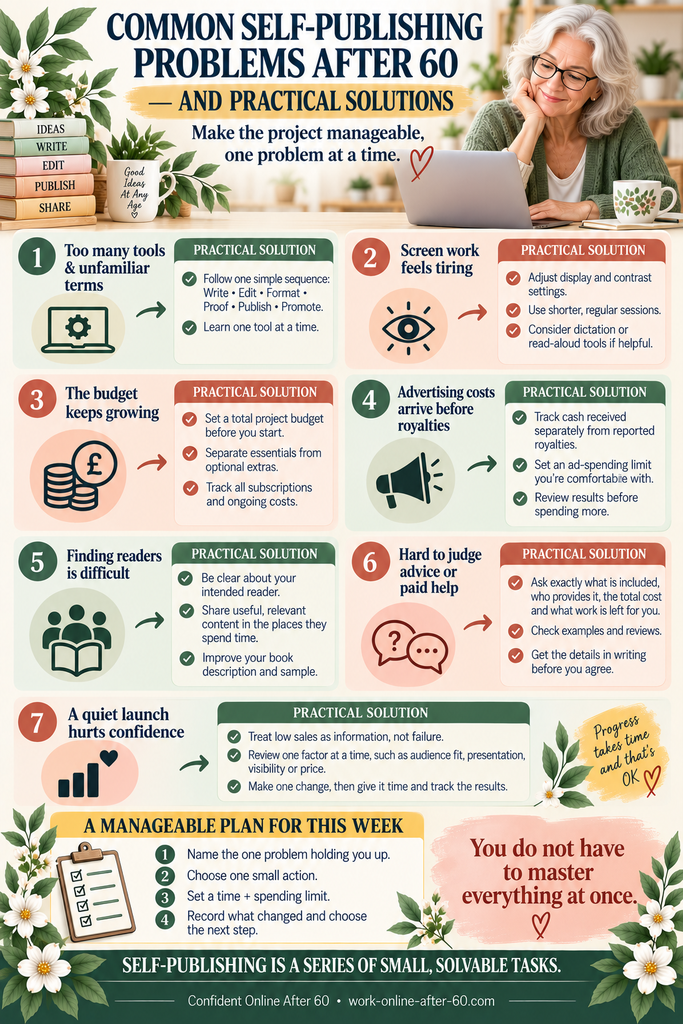
    Problem: too many tools and unfamiliar terms

    A manuscript editor, cover tool, formatting application, publishing dashboard and advertising account can feel like several separate jobs. Trying to learn them all at once makes it harder to remember what each is for.

    Try this: Draw a simple sequence: write, edit, format, proof, publish, promote. Use one tool for the stage you are working on. Keep a short checklist with your own notes and screenshots, stored somewhere you can find easily. Test a few pages before formatting an entire book.

    If you get stuck, name the exact task: “I need page numbers to start after the contents” is easier to solve than “I cannot do publishing”.

    Problem: screen work feels tiring or awkward

    Long sessions may not fit your preferences, energy or accessibility needs. That does not mean the project is beyond you; it may mean the workflow needs adjusting.

    Try this: Use the display size, contrast and reading settings you find comfortable. Divide work into shorter sessions and separate drafting from checking. If dictation or read-aloud tools suit you, test them on a small section and review the output carefully. Choose the method that helps you work accurately.

    Older woman using a laptop at a bright table, illustrating learning self-publishing tasks one step at a time.

    Problem: the budget keeps expanding

    A cover, editing service, software subscription and marketing course can each sound useful. Together they may become a commitment you did not intend to make.

    Try this: Set a total project budget before shopping for services. Divide it into essential work, optional improvements and a reserve. Request a clear scope, sample and terms from a service provider. Avoid paying for several solutions to the same unclear problem.

    Keep ongoing subscriptions on a separate list. A small monthly charge deserves attention if you no longer use the service.

    Problem: advertising costs arrive before royalties

    Waiting for money while continuing to spend can create pressure, even when sales appear in a dashboard. I found this one of the difficult parts of KDP.

    Try this: Track cash received separately from royalties reported. Set an advertising limit that does not depend on an expected payment arriving tomorrow. Our self-publishing income article explains the payment schedule and how to compare royalties with your expenses.

    If a campaign is not meeting your goal, review the figures before adding more money. Buying a different course or switching business models does not automatically solve a cash-flow gap.

    Problem: you do not know how to find readers

    Authors may finish a book without a clear plan for introducing it to the people most likely to care about it. Posting repeatedly in unrelated groups can use time without creating useful conversations.

    Try this: Write one sentence describing the intended reader and the book’s appeal. Choose one relevant place to share helpful content, following its rules. A practical guide might lead to a short tutorial; a memoir might lead to a discussion of its theme. Give people a reason to be interested before asking them to buy.

    Improve the book description and sample as well as your outreach. Getting attention and helping a reader decide are separate tasks.

    Woman with a pen, notebook and laptop, illustrating researching publishing advice and planning manageable next steps.

    Problem: it is hard to judge advice or paid help

    Confident promises can sound reassuring when you are stuck. But a bestseller claim, income screenshot or large discount does not tell you whether a service solves your particular problem.

    Try this: Ask what you will receive, who delivers it, how much work remains for you and what the full cost is. Look for relevant examples and written terms. Read our guide to evaluating publishing and affiliate marketing claims before making a major commitment.

    Problem: a quiet launch knocks your confidence

    Low sales are a business result to investigate, not a verdict on your age or worth as a writer. The explanation could involve audience fit, presentation, visibility, price or other factors.

    Try this: Choose one thing to review at a time. Ask specific readers whether the description is clear or whether the sample matches their expectations. Keep a record of changes so you know what you tested. Protect time for the part of the work you enjoy.
    Common problems seniors face in self-publishing- Passion over profit marketing and making money online for women over 60

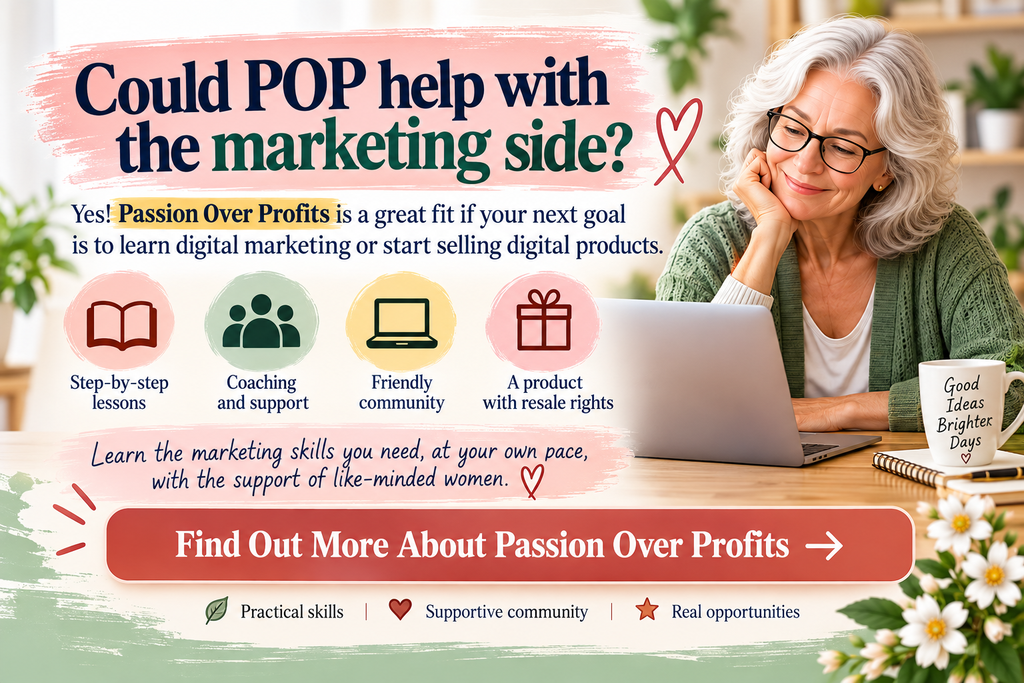
    Could POP help with the marketing side?

    Passion Over Profits may be relevant if your next goal is broader digital marketing education or exploring digital-product selling. The provider describes lessons, coaching and community support, together with a product carrying resale rights.

    It is not a dedicated solution for manuscript formatting, editing or Amazon account problems. If those are your immediate needs, seek help for those tasks first. For POP, confirm that the teaching format, support arrangements, listed US$997 cost and written terms fit your circumstances.

    Explore Passion Over Profits: what’s included, how the model works and whether it fits your goals

    A manageable plan for this week

    1. Write down the single problem holding up your project.
    2. Choose one small action that would improve it.
    3. Set a time and spending limit for that action.
    4. Record what changed and decide the next step.

    You do not have to master every part of an online business in one week. If you are considering a different route alongside publishing, start with the difference between self-publishing and affiliate marketing.

    Am I too old to start self-publishing?

    Age alone does not answer that question. Your goal, available support, preferred workload and willingness to learn are more useful considerations. Begin with a manageable project and evaluate it on those terms.
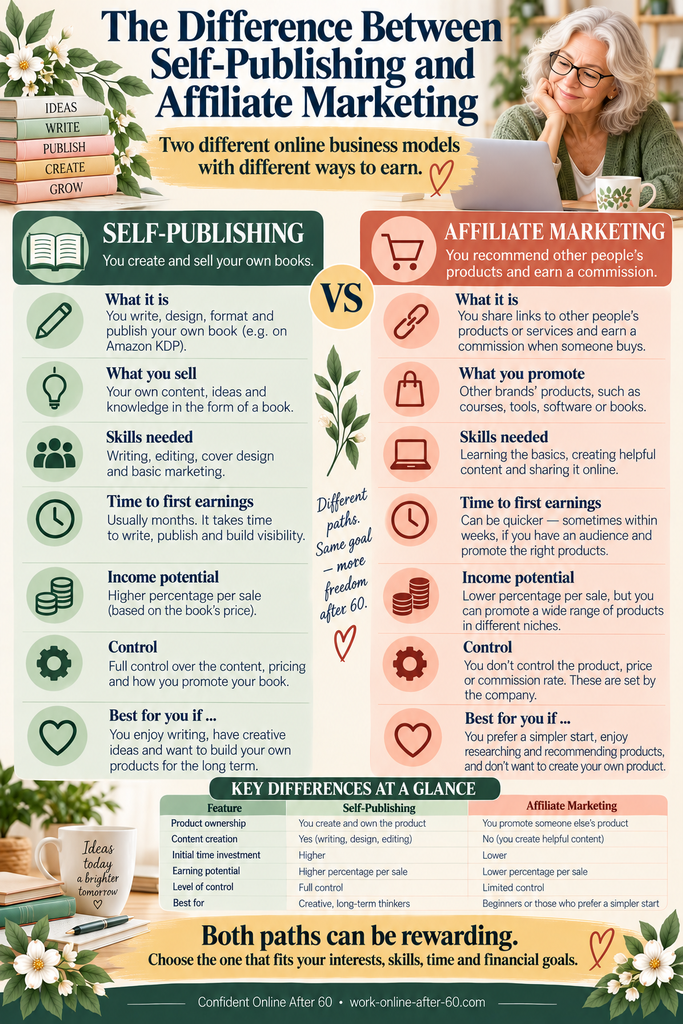

  • The difference between self-publishing and affiliate marketing

    women over 60 ask question what is the difference between self-publishing and affiliate marketing

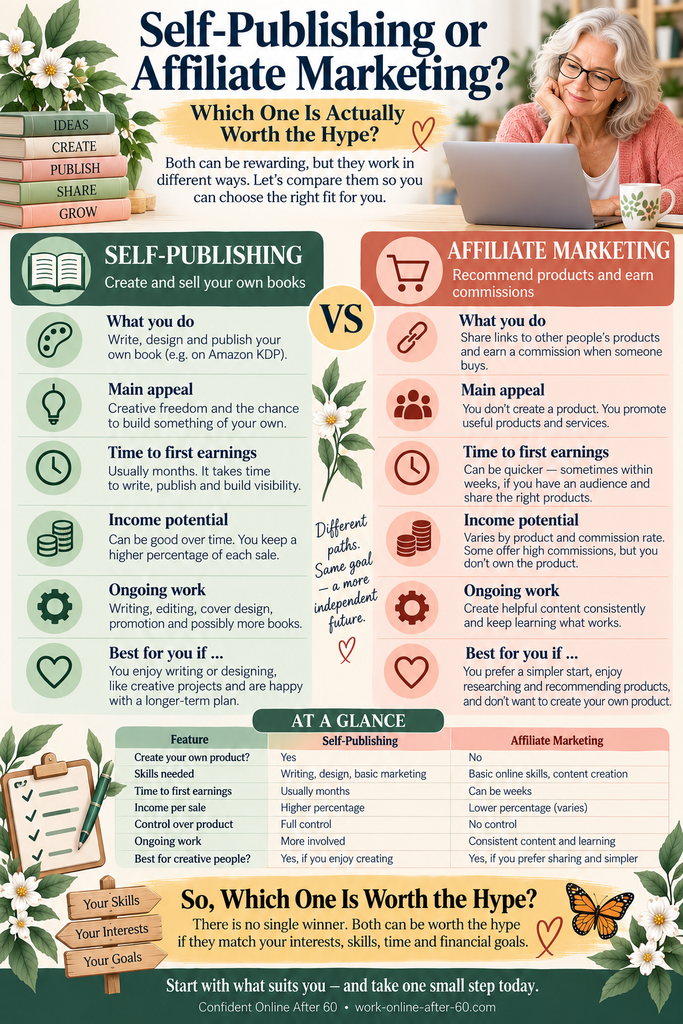
    Self-publishing means bringing your own book to market. Affiliate marketing means recommending another business’s product and earning a commission on qualifying referrals. Both involve marketing, but the product responsibilities and payment arrangements are different.

    This distinction matters if you are an author considering another income stream. Moving into affiliate marketing can remove some product-development tasks. It does not remove the need to understand your audience or earn their trust.

    A quick comparison

    QuestionSelf-publishingAffiliate marketing
    What do you offer?Your bookA referral to another seller’s product
    What do you create?The book and its promotional materialContent that helps people assess or use a product
    How do you earn?Book royalties or proceeds under your selling arrangementCommission under a programme’s rules
    Who controls the product?You, within your rights and agreementsThe product owner or seller
    Is marketing required?Readers must discover and choose the bookPeople must find and act on a relevant recommendation

    Self-publishing: you organise the book

    As a self-publisher, you arrange the manuscript, editing, design, formatting and publication. You may hire help, but the decisions remain part of your project. A platform such as KDP provides publishing and distribution services under its terms.

    Your work continues beyond uploading files. You need to describe the book accurately, keep the presentation suitable for readers and decide how to promote it. If a passage needs correcting, you are responsible for arranging that correction.

    After three years with KDP, I found that the marketing workload was much larger than the act of publishing initially suggested. You can read more about the costs and payment timing in Can you actually make money self-publishing?

    Older woman looking concerned at her laptop, illustrating the need to understand payment rules and business costs.

    Affiliate marketing: you help someone choose

    In an affiliate arrangement, the seller generally provides the product, checkout and customer delivery. Your role is to bring relevant people to the offer using permitted links or other tracking methods. The programme defines what qualifies for a commission and when payment is due.

    Useful affiliate content could be a tutorial, a careful comparison or a product explanation. It should answer the reader’s question first. A link alone is not a business, and adding more links does not necessarily make an article more helpful.

    You remain responsible for your claims. Explain material limitations and make a commission relationship clear. Never imply that you have used a product when your knowledge comes only from its sales page.

    Income follows different rules

    Book earnings depend on the format, selling arrangement and associated deductions. Affiliate earnings depend on the programme’s commission, qualification and payment terms. Returned purchases, cancelled subscriptions or other exclusions can matter.

    Neither the price of a book nor the price of an affiliate product tells you your profit. Compare the amount you receive after costs and the timing of that receipt. Read our guide to looking beyond the hype for examples of why large sales figures can mislead.

    Woman adjusting her glasses while holding a cup on a sofa, alongside discussion of combining writing and affiliate work.

    Master Resell Rights are a third arrangement

    Master Resell Rights, often shortened to MRR, concern a licence to resell a product under specified terms. They are not simply another name for an affiliate commission.

    Before reselling, you need to understand what the licence permits, any pricing or platform restrictions, whether rights can pass to customers and who handles support or disputes. A pre-made product can save creation work while still leaving you with seller responsibilities.

    That distinction is especially relevant to Passion Over Profits. The provider presents POP as training with a resale component and also describes additional affiliate offers. Our detailed guide separates those parts rather than treating all income as the same kind of commission.

    Can an author combine the models?

    Yes, if the audience fit is clear. An author teaching a practical skill might also explain a relevant tool. The book and the recommendation would serve related needs, and the commercial relationship should be disclosed.

    But readers who want a novel are not automatically interested in marketing courses. Self-publishers asking how to develop their business are a different audience. Match each offer to the question the person is actually asking.

    Where to explore POP

    If your interest is learning broader marketing skills and assessing a digital-product business, POP is one programme to investigate. The overview covers the provider’s training and support descriptions, the listed price, licence questions and suitability. It is not a promise of results or a replacement for specialist publishing help.

    difference between self-publishing and affiliate marketing, Passion over profit marketing and making money online for women over 60

    Explore Passion Over Profits: what’s included, how the model works and whether it fits your goals

    Read the self-publishing series

    Which difference matters most for your decision?

    Ask whether you want to create and manage the product, recommend an existing product, or operate under a resale licence. Then examine the everyday work and written terms of that specific route. The label alone cannot tell you whether it fits your goals.

  • Self-publishing or affiliate marketing: which one is actually worth the hype?

    women over 60 ask-Self-publishing or affiliate marketing: which one is actually worth the hype

    Self-publishing and affiliate marketing can both be worthwhile, but neither deserves belief simply because someone shares impressive earnings. The useful comparison is what remains after costs, how much work is involved and whether the model fits your audience and goals.

    My three years in KDP taught me to look beyond the excitement of having a product for sale. Regular advertising costs and the wait for royalty payments made the business more complicated than the publishing step alone suggested.

    Start by defining “worth it”

    For one person, a worthwhile result is completing a book their family can keep. For another, it is earning a modest amount after expenses. Someone else wants a business that can grow without producing a new book each time.

    Write your own goal before comparing offers. Include the time you are willing to spend, the money you can risk and the kind of work you want in your week. Otherwise, someone else’s sales target can quietly become your definition of success.

    Grey-haired woman holding her forehead, illustrating the pressure that unrealistic business expectations can create.

    Five questions to ask about an income claim

    1. Is this revenue, royalty, commission or profit? These figures measure different things.
    2. What expenses are missing? Consider advertising, tools, production and paid support.
    3. How long did the result take? A screenshot may omit months or years of audience building.
    4. What advantages did the person start with? An established audience and earlier experience matter.
    5. Does the example tell us anything about ordinary participants? A selected success story is not evidence of a typical result.

    These questions apply to book publishing, affiliate programmes and course promotions, including POP. A useful explanation should make the model clearer without asking you to treat someone else’s result as your forecast.

    Compare money kept, not just money shown

    Here is an illustration using invented figures. If a book contributes £3 per sale after platform deductions, 50 sales produce £150 before your own expenses. If advertising and other costs total £120, £30 remains before tax and recovery of earlier production costs.

    Suppose a qualifying affiliate sale instead earns a £60 commission. Three approved sales produce £180. With £150 in advertising and tools, £30 remains. Any later reversal could reduce it further.

    The different headline amounts lead to the same result in this example. This does not estimate actual conversion rates or typical income; it shows why commission size alone cannot decide which model is better.

    Older woman seated at a laptop, alongside guidance on researching a digital marketing programme before buying.

    “No product to create” still leaves a business to build

    Affiliate marketing can remove the job of creating the product being sold. You still need to understand that product, make accurate recommendations and reach people who might benefit. Content production, research and maintaining trust are real work.

    Similarly, a ready-made product with resale rights can reduce product-development work, but it does not supply a guaranteed stream of buyers. Reselling also brings responsibilities defined by the licence and selling arrangement.

    “Passive income” can hide ongoing tasks

    A book or article may remain available after you create it. That does not mean earnings continue automatically. Information becomes outdated, offers change, readers ask questions and traffic can fall.

    Consider whether you are comfortable maintaining the work. A smaller collection of useful, current content may be more manageable than a large catalogue you cannot keep up with.

    Do not confuse a sale with cash in your bank

    KDP has a payment lag, discussed in our self-publishing income guide. Affiliate programmes also set payment conditions, and some commissions may be pending before they are approved. Check the actual programme and payment arrangements.

    If cash flow was the difficulty in your previous business, make payment timing one of the first questions you ask about a new one. Do not accept “you keep the sale” as a complete explanation of when funds become available or what costs remain.

    How to assess POP without relying on hype

    The provider presents Passion Over Profits as marketing training with coaching, community resources and a digital product carrying resale rights. Our overview records a listed price of US$997 and explains the provider’s descriptions.

    Ask whether the lessons address the skill you want to develop, whether you can attend or use the support and whether the full cost fits your budget. Read the licence and current purchase terms. The continuing-coaching promise described in the presentation should not be mistaken for a cash payment or guaranteed earnings.

    Explore Passion Over Profits: what’s included, how the model works and whether it fits your goals

    Self-publishing or affiliate marketing- Passion over profit marketing and making money online for women over 60

    A better decision than following the next success story

    Choose a small, measurable experiment. For publishing, that might be improving one book’s description and tracking the outcome. For affiliate marketing, it might be creating a useful comparison for a clearly defined audience without paying for traffic.

    Review the time spent, audience response and costs before expanding. A lack of immediate sales is information to examine, not an automatic reason to buy more training.

    If you are choosing your first project, use our beginner comparison. If creative fulfilment matters as much as money, read how a creative person can choose between publishing and affiliate marketing.

    Is either model worth trying?

    It can be, when the work interests you, the commitment is manageable and you understand the uncertainty. The strongest reason to begin is a clear fit with your goals and a realistic next step, rather than the size of somebody else’s earnings claim.

  • Should a creative person choose self-publishing over affiliate marketing?

    for women over 60 -should a creative person choose self-publishing over affiliate marketing

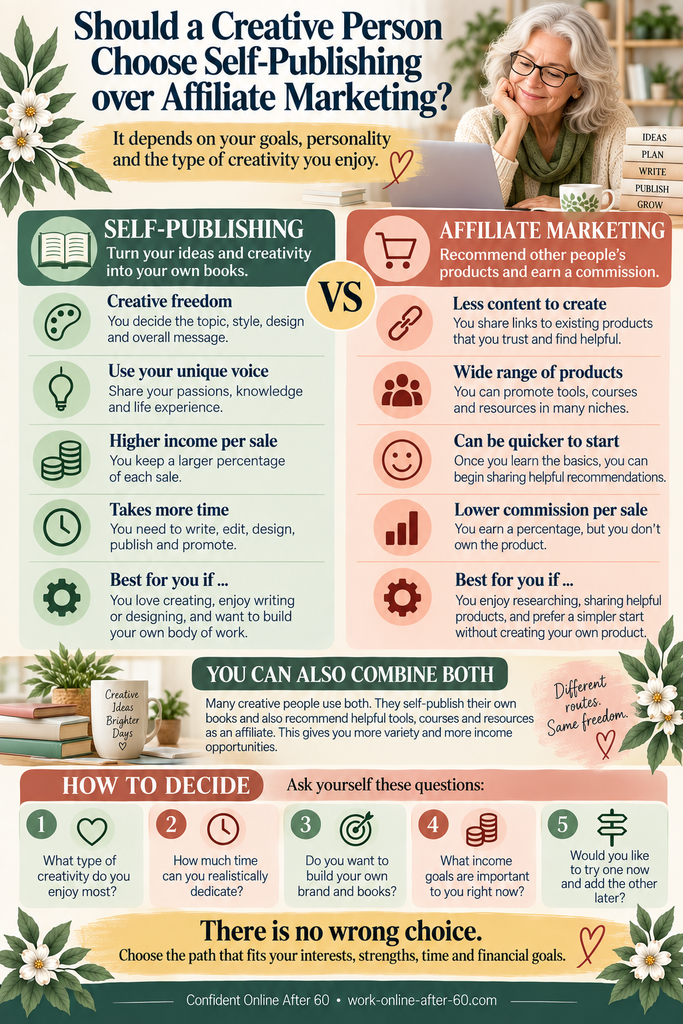
    A creative person should choose self-publishing when making a book is the work they want to do. Affiliate marketing can suit someone who enjoys teaching, explaining or creating useful content around other people’s products. Creativity belongs in both. The better choice depends on what you want to create and how you want that work to support your life.

    It is easy to feel that moving towards marketing means abandoning your identity as a writer. You do not have to make that choice. You can keep a creative project while testing a separate business idea, provided the combined workload remains manageable.

    Ask what you want to own at the end

    Self-publishing can leave you with an original work: a novel, memoir, practical guide or another book you are proud to share. That may have value to you even if sales are modest. If the book itself is the purpose, comparing it only with a commission figure misses something important.

    Affiliate marketing produces a different kind of work. You might create a collection of tutorials, comparisons, demonstrations or newsletters that help people make decisions. You own your original content, subject to any agreements you make, but you do not thereby own the product you recommend.

    Ask yourself: would I still want to make this book if it sold fewer copies than I hoped? Then ask: would I enjoy answering questions about this product if nobody bought it this week? Your answers can reveal which daily activities you are more willing to sustain.

    Woman using a laptop while reclining on a sofa with a cup, illustrating creative work from home.

    The marketing lesson from my KDP experience

    I spent three years self-publishing through Amazon KDP. Looking back, writing felt like roughly a quarter of the effort; marketing took the larger share. That is my personal description of the workload, not a rule for every author.

    The creative part did not make the commercial part disappear. I still had to think about attracting readers and managing costs. That is why I see learning to explain an offer and reach an audience as relevant to creative people, whichever product they choose to sell.

    Creativity in affiliate content can be useful and honest

    A good product explanation involves decisions about structure, language, examples and visuals. Those are creative decisions. A short demonstration that makes a confusing task easier can be valuable work.

    For example, a writer might explain how they organise research and compare suitable tools. A craft enthusiast might demonstrate a technique and discuss the materials involved. The recommendation should arise from the audience’s need, and any commission relationship should be clearly disclosed.

    Creativity does not justify invented reviews. Describe only the experience you actually have. If your article is based on research rather than using the product, say so and show readers the information behind it.

    Older woman adjusting her glasses while reading a laptop screen, illustrating researching helpful content for an audience.

    Your book readers and your business audience may differ

    People who enjoy your fiction may have no interest in running an online business. Sending every reader an unrelated marketing offer can weaken the relationship you worked to build.

    Self-publishers who are actively asking about promotion, digital products or income models are a more natural audience for this discussion. Keep the content relevant to what people chose to hear about. Having someone’s contact details does not automatically mean they want a new kind of promotion.

    A gentle way to test both interests

    1. Protect a writing slot. Reserve a manageable block of time for the book you care about.
    2. Choose one marketing topic. Pick a question you can answer accurately from experience and research.
    3. Create one useful piece. Publish an explanation or tutorial before committing to a large content schedule.
    4. Review the fit. Notice whether the work feels interesting, whether readers find it useful and whether the time commitment is sustainable.

    You do not need to build two full businesses immediately. A small experiment can help you decide whether combining them is enjoyable or simply exhausting.

    self-publishing over affiliate marketing- Passion over profit marketing and making money online for women over 60

    When could POP be relevant?

    Passion Over Profits may appeal if you want to explore structured digital marketing education and the possibility of selling an existing digital product. Its provider describes training and community support alongside resale rights.

    That could be relevant to a creative person who wants help understanding marketing. It does not teach every aspect of writing or publishing, and a resale licence is not ownership of your own original course. Whether the programme is worthwhile depends on your learning needs, the terms and the time you can give it.

    Explore Passion Over Profits: what’s included, how the model works and whether it fits your goals

    Questions creative people often ask

    Does choosing affiliate marketing mean giving up my book?

    No. You can set separate creative and commercial goals. Avoid promising yourself that an untested income stream will fund the book until it actually produces dependable money.

    Should I choose whichever has the highest potential income?

    Potential is not a forecast. Consider the work you can deliver well, the audience you understand and the costs you can manage. High headline earnings say little about your likely experience.

    What if I only want to write?

    That is a valid goal. Decide whether you want writing as a personal project, a publishing business or a paid service. Each involves different trade-offs. Our beginner comparison can help you choose a small next step.

  • Which is better for beginners, self-publishing or affiliate marketing?

    Which is better for beginners, self-publishing or affiliate marketing for womens

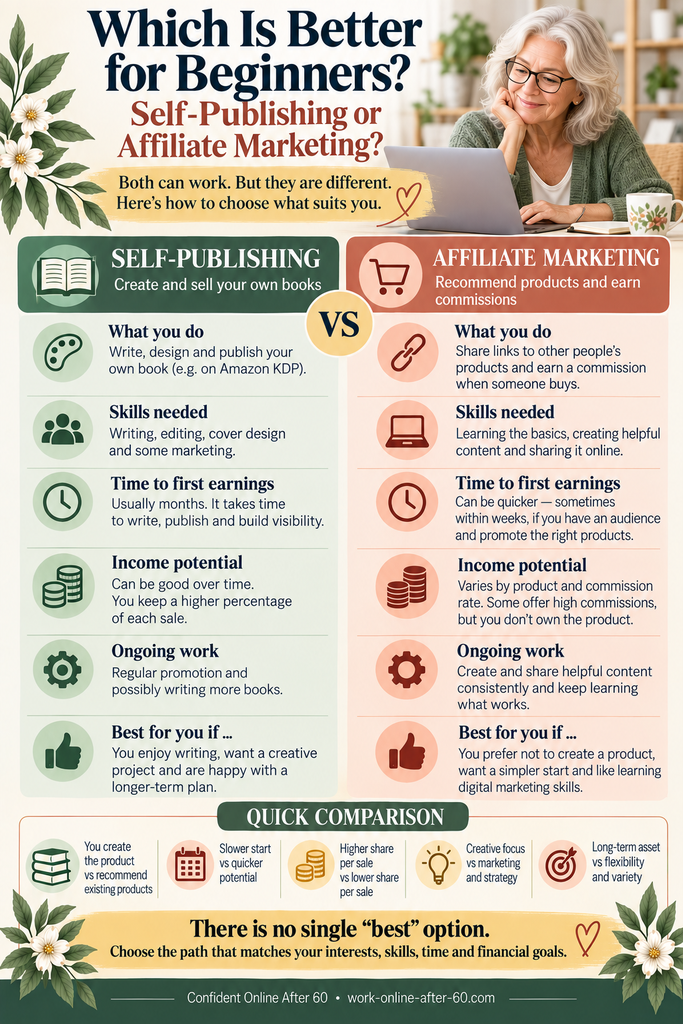
    Affiliate marketing may be simpler for a beginner who wants to practise marketing without creating a book first. Self-publishing may be the better fit when producing a book is the main goal. Neither is automatically easier to earn from. Both need an audience, useful content and a way to turn interest into a purchase.

    After three years in KDP, my strongest lesson was that completing the product did not complete the business. Before choosing your route, consider which work you actually want to do and which skills you want to learn.

    Choose the outcome before the business model

    “I want to publish my story” and “I want to learn how to earn by recommending useful products” are different ambitions. The first points towards authorship. The second points towards affiliate marketing. You can pursue both eventually, but beginning with two unfamiliar businesses can make it harder to understand what is working.

    If you need predictable income soon, neither model should be treated as a dependable solution. A defined service with an agreed fee may be a more suitable option to investigate while you develop longer-term projects.

    Older woman with glasses seated at a laptop, illustrating getting started with an online publishing or affiliate project.

    What would you do first as a self-publisher?

    You would decide who the book is for, develop the manuscript and prepare it for readers. That includes decisions about editing, cover design, formatting, pricing and distribution. You can do some tasks yourself or pay for selected help.

    A good beginner experiment is smaller than “write a whole series”. Prepare a clear book concept and one sample chapter, then ask suitable readers whether the promise is interesting and the writing delivers it. Feedback is not proof of sales, but it can reveal confusion before you invest in a finished product.

    What would you do first as an affiliate marketer?

    You would choose an audience, identify a problem you understand and investigate products that might help. A participating affiliate programme provides the terms for referrals and commissions. You create useful content and make your commercial relationship clear when recommending through affiliate links.

    A good first experiment is one helpful tutorial or comparison based on accurate knowledge. Explain who a product is for, what it does and where it falls short. Check the programme’s approval requirements and permitted promotional methods before adding links.

    You do not avoid writing by choosing affiliate marketing. You may write articles, emails, explanations or video scripts instead of chapters. You also need to keep recommendations up to date.

    Which costs are you prepared to manage?

    Self-publishing can involve editing, covers, proofs and promotion. Affiliate marketing can involve websites, email tools, content production and optional training. The exact costs depend on your choices; neither route requires buying every tool a course creator recommends.

    Write down a maximum test budget, including subscriptions after any introductory price ends. Separate costs you must pay now from optional upgrades. Do not compare an expensive publishing plan with a supposedly free affiliate plan unless both genuinely match what you intend to do.

    Woman waving during a laptop video call from her sofa, illustrating online communication as part of working from home.

    Which daily tasks suit you?

    • Choose a book-first experiment if you enjoy sustained writing, have a clear reader in mind and want your own finished work.
    • Choose an affiliate-first experiment if you enjoy explaining and comparing products and want to practise reaching an audience before creating a large product.
    • Pause both if the main attraction is a promise of quick, effortless income or if the proposed spending would be uncomfortable.

    Being a beginner after 60 does not mean starting without useful knowledge. Experience in a hobby or profession may help you understand people’s questions. It still needs to be paired with current product knowledge and practice.

    A four-week way to explore your choice

    1. Week one: Define one audience and one question or reading experience you want to serve.
    2. Week two: Create a small sample: a chapter for the book route or a useful article for the affiliate route.
    3. Week three: Share appropriately with relevant people and ask specific questions about clarity and usefulness.
    4. Week four: Review the work, feedback, time and costs. Decide what the next small test should be.

    This is a learning plan, not a four-week earnings forecast. A small test can help you notice whether you enjoy the work before committing to a larger purchase or project.

    Passion over profit marketing and making money online for women over 60

    Is POP an option for beginners?

    The provider presents Passion Over Profits as digital marketing education with support and a product carrying resale rights. It may appeal if you want a structured learning route and are interested in selling an existing digital product.

    Its main resale component is different from simply joining an affiliate programme. The listed US$997 purchase is a significant commitment, and the licence, support and additional costs deserve a careful look. POP is optional; you do not have to buy it to explore affiliate marketing.

    Explore Passion Over Profits: what’s included, how the model works and whether it fits your goals

    Questions beginners often ask

    Which route pays faster?

    There is no reliable universal answer. You must first attract a buyer, and payment schedules vary. Compare actual terms rather than treating a sales notification as available cash.

    Can I publish books and recommend products?

    Yes, if the recommendations fit your audience and follow the relevant rules. Start with one manageable project so you can judge the workload.

    Where should I look next?

    Read the practical economics of self-publishing and the downsides and ways to manage them before deciding how much to invest.

  • What are the downsides of self-publishing?

    for women over 60 the downsides of self-publishing are explain

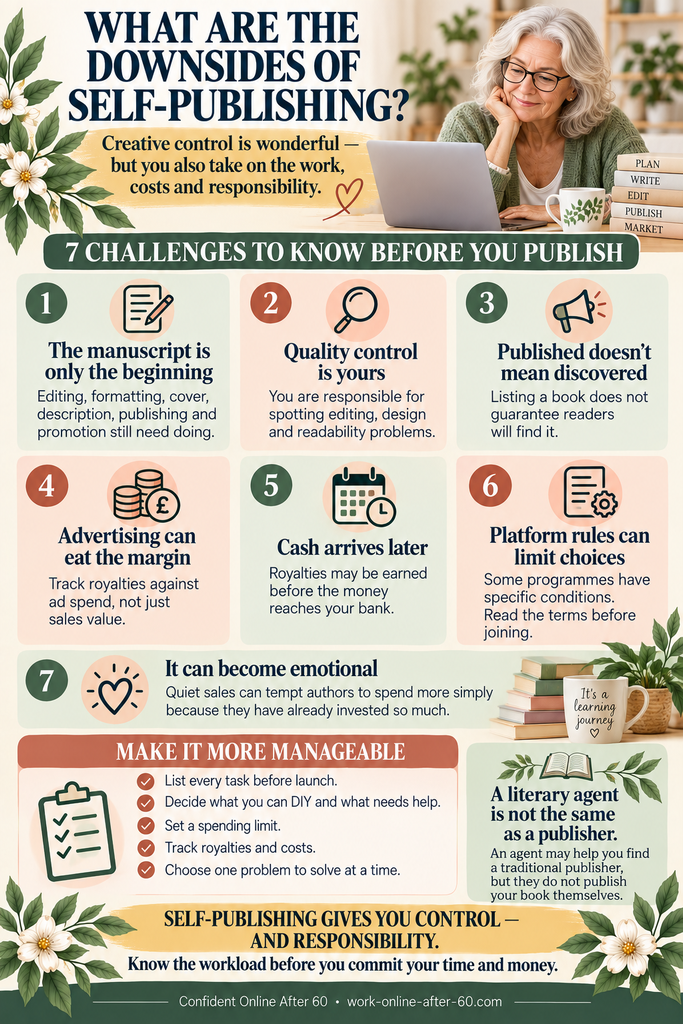
    The main downsides of self-publishing are the workload, uncertain sales, upfront costs, responsibility for quality and the need to find readers. You gain control over your book, but you also take on jobs that a publishing team might otherwise share.

    During my three years with Amazon KDP, the pressure to keep funding advertising and the wait for royalty payments were especially frustrating. Understanding those pressures before you publish can help you make a calmer decision about your time and money.

    1. The manuscript is only one part of the job

    A finished manuscript still needs editing, formatting, a cover, a description and a publication plan. After launch, there is promotion, administration and possibly updating the book. Doing every task yourself can stretch a project far beyond the writing stage.

    A practical response: List the tasks before setting a launch date. Decide what you can do well, what you can learn and what might need paid help. Keep the first project manageable rather than trying to publish several formats simultaneously.

    2. Creative control brings quality-control responsibility

    You choose the content and presentation, which is a real benefit. You also have to notice when the cover gives the wrong impression, the interior is difficult to read or the manuscript needs another edit. Familiarity with your own writing can make errors harder to spot.

    A practical response: Separate drafting from proofreading. Ask an appropriate reader for specific feedback and check a proof in the format people will use. A cover that looks clear on a large screen should also be recognisable as a small image.

    Person taking a video call on a smartphone while sitting on a sofa at home.

    3. Being listed does not mean being discovered

    Publishing makes a book available. It does not guarantee that the right people will notice it or understand why they would enjoy it. Amazon’s merchandising guidance discusses descriptions, author profiles and promotion alongside the book itself.

    A practical response: Describe one intended reader and their reason for choosing the book. For fiction, that could be a particular reading experience; for nonfiction, a question the book helps answer. Use that understanding to improve the description and choose relevant places to share it.

    4. Advertising can consume the margin

    In my experience, maintaining enough sales felt tied to regular ad spending. Other authors may build readership differently. The problem to watch is paying more to acquire a sale than that sale contributes to your business.

    A practical response: Set a test budget and record royalties alongside spend. If an ad dashboard shows retail sales value, do not mistake that value for the royalty you receive. Future sales of other books may matter, but they should be measured rather than assumed.

    Person reviewing a printed spreadsheet during a laptop video meeting, alongside discussion of publishing marketing costs.

    5. Cash arrives later than the sale

    Royalty reporting and bank payments happen on different schedules. That can be awkward when current costs depend on money you have earned but have not received. Our guide to whether you can make money self-publishing explains KDP’s payment timing and a simple profit calculation.

    A practical response: Keep a calendar of expected receipts and bills. Decide in advance how much you can spend without relying on the next royalty payment.

    6. Platform rules can limit your choices

    Different distribution arrangements come with different conditions. For example, enrolling a Kindle eBook in the optional KDP Select programme involves a 90-day digital exclusivity commitment. This is not a blanket rule for every KDP book. Read Amazon’s KDP Select requirements before enrolling or distributing that eBook elsewhere.

    A practical response: Keep a record of the programmes you join and their renewal dates. Read the terms for the specific format and arrangement rather than relying on advice about another author’s setup.

    7. The emotional investment can make decisions harder

    When a book matters deeply to you, quiet sales can feel personal. It is tempting to buy another service or run another campaign simply to justify the work already invested.

    A practical response: Separate the creative goal from the commercial one. Completing a memoir for family and building a profitable catalogue are different aims. Set a review date and decide what evidence would justify continuing, changing direction or pausing expenditure.

    the downsides of self-publishing - Passion over profit marketing and making money online for women over 60

    Does a literary agent remove these problems?

    A literary agent generally represents an author in dealings with publishers; an agent is not the same as a publisher. Traditional publishers can provide editing, design, marketing and publicity support, with arrangements varying by book and contract. See Penguin’s explanations of literary agents and a publisher’s role.

    It would therefore be misleading to say every author has exactly the same marketing workload, whichever route they take. Ask what support a particular arrangement actually includes.

    Could learning broader marketing skills help?

    If attracting buyers is the part you want to understand better, POP is one programme to investigate. Its provider describes digital marketing training and a product with resale rights. That may interest authors exploring another income model alongside writing.

    It does not replace editing, provide a publishing contract or guarantee profitable book advertising. Our programme guide explains its scope, cost and suitability so you can compare it with the help you actually need.

    Explore Passion Over Profits: what’s included, how the model works and whether it fits your goals

    One useful step before your next book

    Write down the task that is currently slowing you down. Solve that problem first. Better proofreading, a clearer description and learning to market are different needs; choosing the right help starts with naming the right problem.

    Based on Silviya’s KDP experience and the linked provider guidance, checked on 25 September 2026.

  • Can you actually make money self-publishing?

    women over 60 making money in self-publishing on amazon KDP

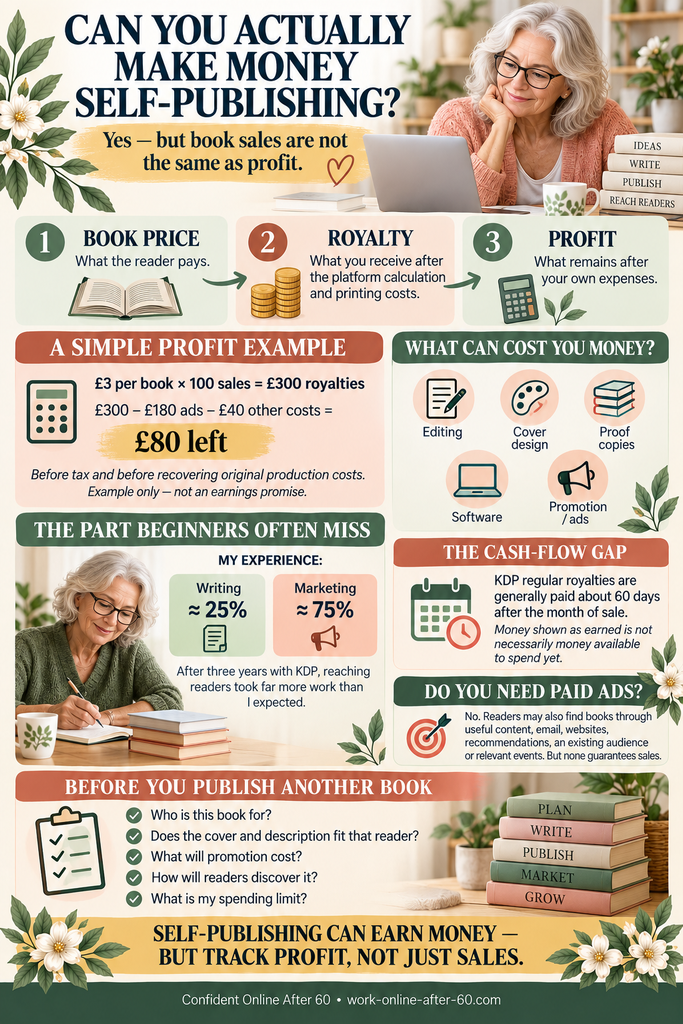
    It is possible to make money by self-publishing, but selling books and actually making a profit are not the same. How much you earn depends on your royalties, production and promotion costs, and the time you invest. Even after publishing, your book still needs readers.

    I spent three years self-publishing with Amazon KDP. For me, it was hard to sell enough books without paying for ads regularly. Waiting for royalties to arrive in my bank account was another challenge. This is just my experience—other authors may have different results or not need paid ads.

    So, what does it really mean to make money from a book?

    First, break things down into three numbers: what the reader pays, the royalty you receive, and what is left after your expenses. If a book sells for £10, you do not get to keep all £10.

    For KDP paperbacks sold through Amazon, royalties are usually 50% or 60%, depending on the price and marketplace, and printing costs are taken out after that. You can check your own book’s format and price using Amazon’s royalty guidance and calculator. eBooks have a different royalty calculation.

    Next, include costs like editing, cover design, proof copies, software, and any promotion you pay for. Keep track of your time too, even if you do not pay yourself by the hour. This helps you see if your project is meeting your financial and personal goals.

    Older woman typing on a laptop at home, alongside an explanation of book royalties and publishing expenses.

    A simple profit example

    Let’s say you make £3 from each book sold after the platform takes its share. If you sell 100 copies, you’ll earn £300 in royalties. If you spend £180 on ads and £40 on other costs during that time, you’ll have £80 left before tax and before paying back what you spent to produce the book.

    If you paid £400 for the cover and editing, the £80 left over hasn’t covered your original costs yet. These numbers are just examples to show how the calculation works—they aren’t typical sales, costs, or earnings.

    Each month, keep a simple record of your royalties earned, the money you actually receive, your ad spending, other costs, and the hours you worked. It’s especially helpful with KDP to track what you’ve earned separately from what you’ve received.

    Why the wait for KDP payments matters

    Amazon pays regular KDP royalties about 60 days after the month when the sale was reported, and 90 days for Expanded Distribution. For example, royalties from January are usually paid at the end of March. Payment thresholds and bank processing times can also affect when the money arrives. Check KDP’s payment schedule for details.

    This is why it can feel like you’re waiting three months to get paid for a sale made early in the month. In the meantime, you might already have to pay for ads or other bills. Money listed in your report isn’t available to spend yet.

    Set a spending limit you’re comfortable with while you wait for payments. Don’t assume that putting more money into a campaign will always make it profitable.

    Person in a checked shirt using a tablet, illustrating researching ways to reach readers online.

    Can you sell books without paying for ads?

    Paid ads are just one way to promote a book, but they are not required. Amazon also suggests using email, websites, and other ways to reach readers. People might find your book through helpful content, recommendations, your existing audience, or events that relate to your topic.

    These methods still require effort, and none can promise sales. It helps to first check if your cover, description, and sample fit the readers you want. Getting more visitors will not fix a mismatch between your book and its audience.

    The lesson I took from three years of publishing

    In my experience, writing made up about 25% of the work, while marketing took the other 75%. This is just how it felt to me, not an official industry number. Finishing the manuscript was a big step, but figuring out how to reach readers turned out to be a much bigger part of the process than I thought.

    If you see yourself facing this challenge, try to figure out what you need to learn next before starting another book. Do you need to explain your book’s benefits better, find the right readers, improve your sales page, or choose which promotional activity is worth your time?

    make money self-publishing with Passion over profit marketing and making money online for women over 60

    Where Passion Over Profits fits

    POP may interest a self-publisher who wants to explore broader digital marketing skills and selling digital products. The provider describes training, community support and a product with resale rights. It is not a specialist KDP advertising service, and buying it will not shorten Amazon’s payment schedule or guarantee more book sales.

    You can keep writing while considering another model. Our guide explains the distinction between affiliate commissions and resale rights, the listed US$997 price and the practical questions to ask.

    Explore Passion Over Profits: what’s included, how the model works and whether it fits your goals

    Frequently asked questions

    Does self-publishing provide passive income?

    A book can continue selling after publication, but production, promotion and maintenance still take work. Whether it earns anything consistently depends on demand and other factors.

    Should I stop publishing if one book earns very little?

    One result does not answer every question. Review the audience, costs and purpose of the book. Continue, revise or pause because of what you learn, rather than because you have already spent money.

    Can affiliate marketing fix a cash-flow problem?

    Do not assume so. Affiliate programmes have their own payment schedules, qualification rules and possible reversals. Compare the actual terms before treating a new model as faster income.

    Written from Silviya’s three years of KDP experience. Linked Amazon guidance checked on 25 September 2026.

    Continue the self-publishing series

    Explore the difference between self-publishing and affiliate marketing, with links to all seven articles on choosing a model, managing the workload and making a realistic plan.