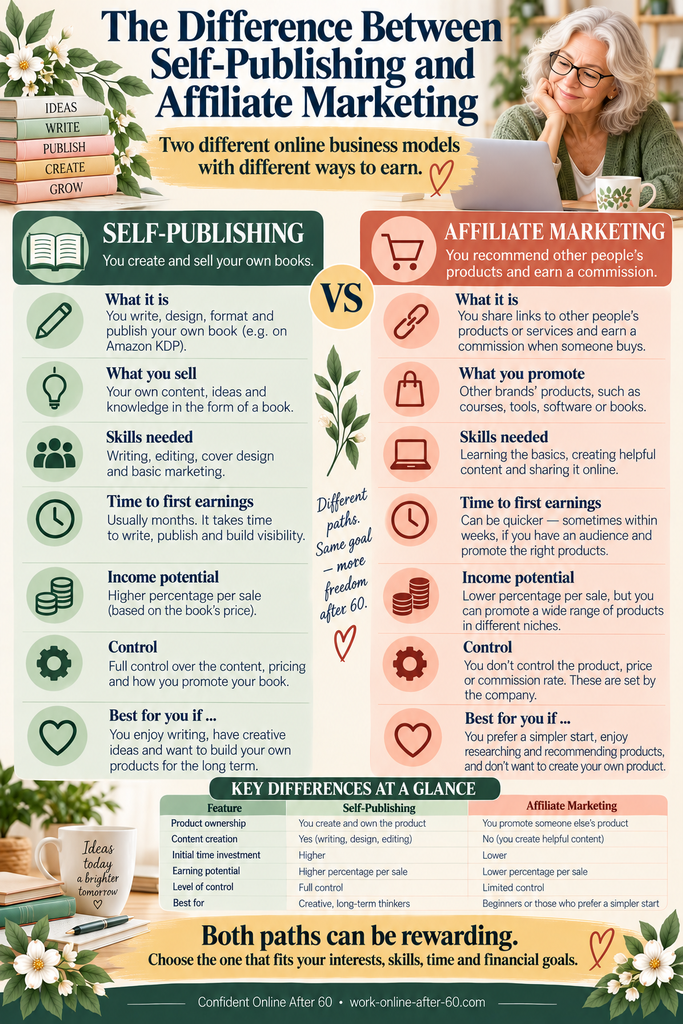
Self-publishing means bringing your own book to market. Affiliate marketing means recommending another business’s product and earning a commission on qualifying referrals. Both involve marketing, but the product responsibilities and payment arrangements are different.
This distinction matters if you are an author considering another income stream. Moving into affiliate marketing can remove some product-development tasks. It does not remove the need to understand your audience or earn their trust.
A quick comparison
| Question | Self-publishing | Affiliate marketing |
|---|---|---|
| What do you offer? | Your book | A referral to another seller’s product |
| What do you create? | The book and its promotional material | Content that helps people assess or use a product |
| How do you earn? | Book royalties or proceeds under your selling arrangement | Commission under a programme’s rules |
| Who controls the product? | You, within your rights and agreements | The product owner or seller |
| Is marketing required? | Readers must discover and choose the book | People must find and act on a relevant recommendation |
Self-publishing: you organise the book
As a self-publisher, you arrange the manuscript, editing, design, formatting and publication. You may hire help, but the decisions remain part of your project. A platform such as KDP provides publishing and distribution services under its terms.
Your work continues beyond uploading files. You need to describe the book accurately, keep the presentation suitable for readers and decide how to promote it. If a passage needs correcting, you are responsible for arranging that correction.
After three years with KDP, I found that the marketing workload was much larger than the act of publishing initially suggested. You can read more about the costs and payment timing in Can you actually make money self-publishing?

Affiliate marketing: you help someone choose
In an affiliate arrangement, the seller generally provides the product, checkout and customer delivery. Your role is to bring relevant people to the offer using permitted links or other tracking methods. The programme defines what qualifies for a commission and when payment is due.
Useful affiliate content could be a tutorial, a careful comparison or a product explanation. It should answer the reader’s question first. A link alone is not a business, and adding more links does not necessarily make an article more helpful.
You remain responsible for your claims. Explain material limitations and make a commission relationship clear. Never imply that you have used a product when your knowledge comes only from its sales page.
Income follows different rules
Book earnings depend on the format, selling arrangement and associated deductions. Affiliate earnings depend on the programme’s commission, qualification and payment terms. Returned purchases, cancelled subscriptions or other exclusions can matter.
Neither the price of a book nor the price of an affiliate product tells you your profit. Compare the amount you receive after costs and the timing of that receipt. Read our guide to looking beyond the hype for examples of why large sales figures can mislead.

Master Resell Rights are a third arrangement
Master Resell Rights, often shortened to MRR, concern a licence to resell a product under specified terms. They are not simply another name for an affiliate commission.
Before reselling, you need to understand what the licence permits, any pricing or platform restrictions, whether rights can pass to customers and who handles support or disputes. A pre-made product can save creation work while still leaving you with seller responsibilities.
That distinction is especially relevant to Passion Over Profits. The provider presents POP as training with a resale component and also describes additional affiliate offers. Our detailed guide separates those parts rather than treating all income as the same kind of commission.
Can an author combine the models?
Yes, if the audience fit is clear. An author teaching a practical skill might also explain a relevant tool. The book and the recommendation would serve related needs, and the commercial relationship should be disclosed.
But readers who want a novel are not automatically interested in marketing courses. Self-publishers asking how to develop their business are a different audience. Match each offer to the question the person is actually asking.
Where to explore POP
If your interest is learning broader marketing skills and assessing a digital-product business, POP is one programme to investigate. The overview covers the provider’s training and support descriptions, the listed price, licence questions and suitability. It is not a promise of results or a replacement for specialist publishing help.
Explore Passion Over Profits: what’s included, how the model works and whether it fits your goals
Read the self-publishing series
- Can you actually make money self-publishing?
- What are the downsides of self-publishing?
- Which is better for beginners, self-publishing or affiliate marketing?
- Should a creative person choose self-publishing over affiliate marketing?
- Self-publishing or affiliate marketing: which one is actually worth the hype?
- Common problems seniors face in self-publishing—and practical solutions
Which difference matters most for your decision?
Ask whether you want to create and manage the product, recommend an existing product, or operate under a resale licence. Then examine the everyday work and written terms of that specific route. The label alone cannot tell you whether it fits your goals.
Leave a Reply