
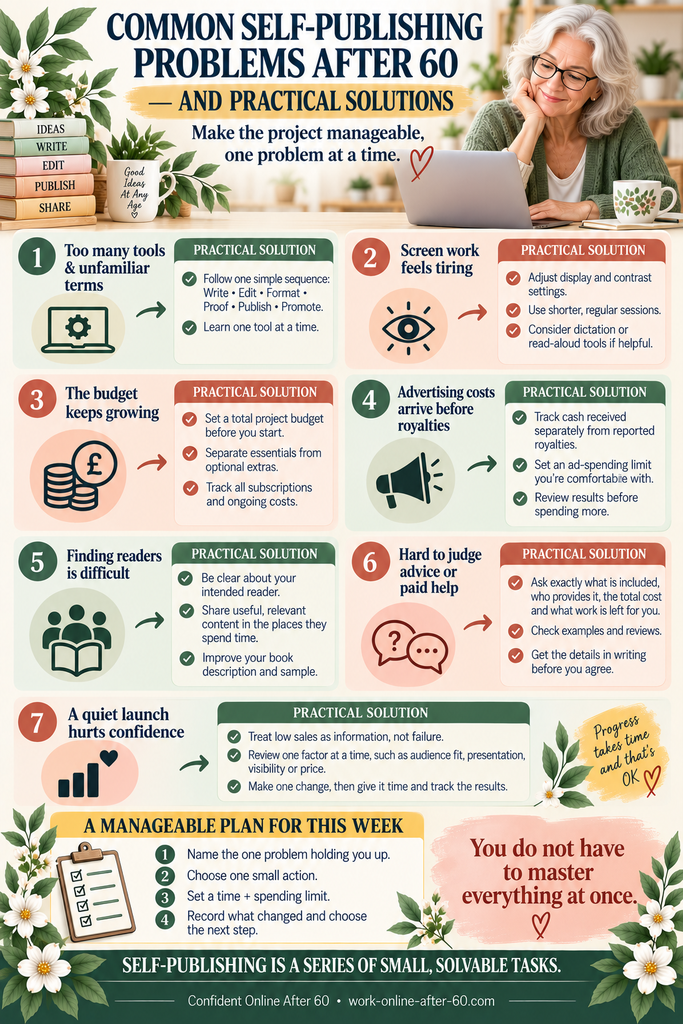
Publishing after 60 can involve unfamiliar technology, a demanding workload, uncertain sales and decisions about where to spend money. These challenges are not unique to older authors, and age does not determine your ability to learn. The useful response is to break the work into smaller decisions and get help where it makes a practical difference.
I spent three years self-publishing with Amazon KDP. Advertising costs and the wait for royalties were problems I experienced directly. This guide combines those lessons with practical suggestions for making a publishing project more manageable.
Problem: too many tools and unfamiliar terms
A manuscript editor, cover tool, formatting application, publishing dashboard and advertising account can feel like several separate jobs. Trying to learn them all at once makes it harder to remember what each is for.
Try this: Draw a simple sequence: write, edit, format, proof, publish, promote. Use one tool for the stage you are working on. Keep a short checklist with your own notes and screenshots, stored somewhere you can find easily. Test a few pages before formatting an entire book.
If you get stuck, name the exact task: “I need page numbers to start after the contents” is easier to solve than “I cannot do publishing”.
Problem: screen work feels tiring or awkward
Long sessions may not fit your preferences, energy or accessibility needs. That does not mean the project is beyond you; it may mean the workflow needs adjusting.
Try this: Use the display size, contrast and reading settings you find comfortable. Divide work into shorter sessions and separate drafting from checking. If dictation or read-aloud tools suit you, test them on a small section and review the output carefully. Choose the method that helps you work accurately.

Problem: the budget keeps expanding
A cover, editing service, software subscription and marketing course can each sound useful. Together they may become a commitment you did not intend to make.
Try this: Set a total project budget before shopping for services. Divide it into essential work, optional improvements and a reserve. Request a clear scope, sample and terms from a service provider. Avoid paying for several solutions to the same unclear problem.
Keep ongoing subscriptions on a separate list. A small monthly charge deserves attention if you no longer use the service.
Problem: advertising costs arrive before royalties
Waiting for money while continuing to spend can create pressure, even when sales appear in a dashboard. I found this one of the difficult parts of KDP.
Try this: Track cash received separately from royalties reported. Set an advertising limit that does not depend on an expected payment arriving tomorrow. Our self-publishing income article explains the payment schedule and how to compare royalties with your expenses.
If a campaign is not meeting your goal, review the figures before adding more money. Buying a different course or switching business models does not automatically solve a cash-flow gap.
Problem: you do not know how to find readers
Authors may finish a book without a clear plan for introducing it to the people most likely to care about it. Posting repeatedly in unrelated groups can use time without creating useful conversations.
Try this: Write one sentence describing the intended reader and the book’s appeal. Choose one relevant place to share helpful content, following its rules. A practical guide might lead to a short tutorial; a memoir might lead to a discussion of its theme. Give people a reason to be interested before asking them to buy.
Improve the book description and sample as well as your outreach. Getting attention and helping a reader decide are separate tasks.

Problem: it is hard to judge advice or paid help
Confident promises can sound reassuring when you are stuck. But a bestseller claim, income screenshot or large discount does not tell you whether a service solves your particular problem.
Try this: Ask what you will receive, who delivers it, how much work remains for you and what the full cost is. Look for relevant examples and written terms. Read our guide to evaluating publishing and affiliate marketing claims before making a major commitment.
Problem: a quiet launch knocks your confidence
Low sales are a business result to investigate, not a verdict on your age or worth as a writer. The explanation could involve audience fit, presentation, visibility, price or other factors.
Try this: Choose one thing to review at a time. Ask specific readers whether the description is clear or whether the sample matches their expectations. Keep a record of changes so you know what you tested. Protect time for the part of the work you enjoy.

Could POP help with the marketing side?
Passion Over Profits may be relevant if your next goal is broader digital marketing education or exploring digital-product selling. The provider describes lessons, coaching and community support, together with a product carrying resale rights.
It is not a dedicated solution for manuscript formatting, editing or Amazon account problems. If those are your immediate needs, seek help for those tasks first. For POP, confirm that the teaching format, support arrangements, listed US$997 cost and written terms fit your circumstances.
Explore Passion Over Profits: what’s included, how the model works and whether it fits your goals
A manageable plan for this week
- Write down the single problem holding up your project.
- Choose one small action that would improve it.
- Set a time and spending limit for that action.
- Record what changed and decide the next step.
You do not have to master every part of an online business in one week. If you are considering a different route alongside publishing, start with the difference between self-publishing and affiliate marketing.
Am I too old to start self-publishing?
Age alone does not answer that question. Your goal, available support, preferred workload and willingness to learn are more useful considerations. Begin with a manageable project and evaluate it on those terms.
Leave a Reply